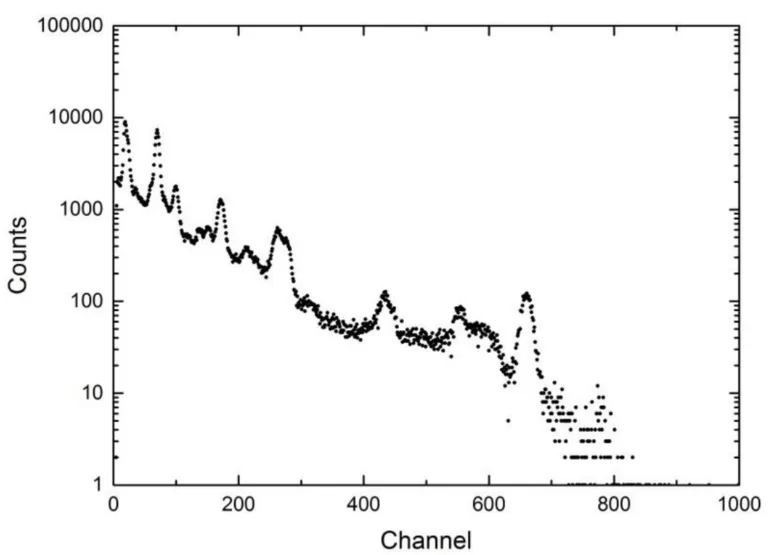
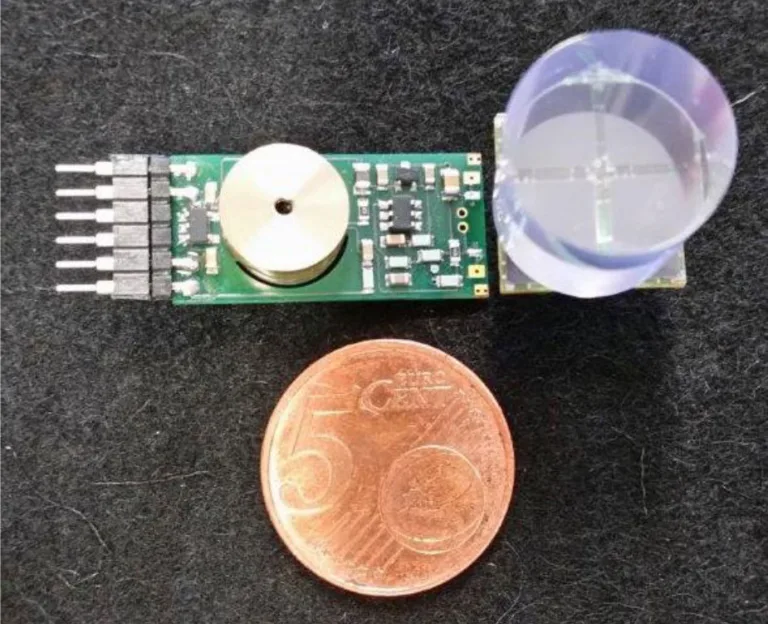
An alternative to the readout of scintillation crystals with photomultiplier tubes is the use of so-called silicon photomultipliers (SiPms).
SiPm elements can be combined into matrices. SiPms can be operated up to 60 degrees C.
For applications where small size and low voltage operations are required, SiPm readout of scintillators can be a good choice. SiPms behave totally different from classical photomultiplier tubes, as well with respect to signal processing as to spectroscopic behavior.
The gain of SiPms is a very strong function of the bias voltage which should be chosen carefully depending on the
actual application of the detector. The number of SiPms needed on a scintillation crystal depends on the
requirements.
SCIONIX has developed a range of sensors equipped with SiPms for a great variety of applications.
The energy resolution and noise level achievable with SiPm readout depends on the crystal dimensions, type of scintillator and area covered by the SiPm; some examples
| Crystal size and type | Energy resolution (662 keV) |
| NaI(Tl) 32 x 25 mm | < 8.0 % |
| CsI(Tl) 25 x 25 mm | < 7.0 % |
| CsI(Tl) 35 x 51 | < 7.5 % |
| CsI(Tl) 48 x 35 mm | < 7.5 % |
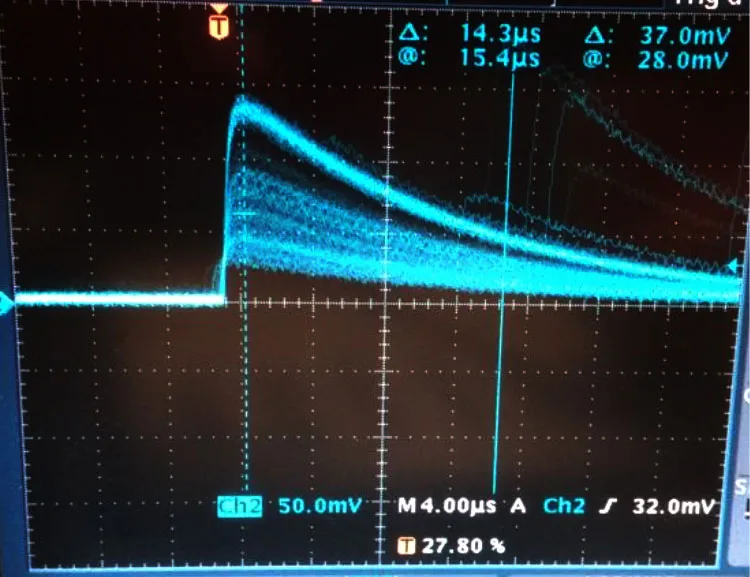
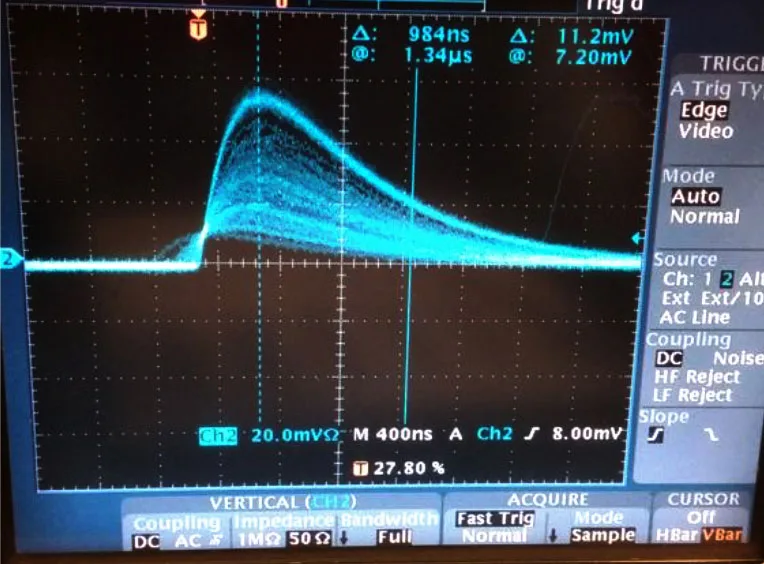
The signal of a SiPm detector depends very strongly on the termination resistor. A typical example of a bare NaI(Tl) SiPm signal is shown here:
SCIONIX has developed bias generator/preamplifier modules for SiPm scintillation detectors. The gain drift as a function of temperature is internally corrected. Such modules operate at voltage 5.2 – 16V and consume less than 30 mW.